Custom Composite Models
In ParamRF, models can contain other models, referred to as composite models. The following example builds on top of the Custom Parametric Models example to demonstrate how to build these effectively.
Before we do this, it is useful to note the following two rules when creating custom models:
Models are immutable. If you want to change the structure of a model given an existing one, either implement your model in such a way that it can be “replaced” with relevant changes specified using
pmrf.replace(), or create a helper method named something like.with_structurethat returns a new model.Only store state required to reconstruct the model. Avoid storing values that can be trivially derived from other fields. Only store configuration parameters that are required to preserve the model’s structure when creating modified copies.
The above rules help prevent subtle bugs when performing advanced model manipulation.
Defining a Multi-Stage Filter
When building composite models, it is often desirable to initialize a model based on higher-level specifications. For example, you may want to specify the number of stages of a filter or its cuttoff frequency. It is best to handle this purely as an initialization step, especially because such variables can fundamentally change the model’s structure. To demonstrate this, let’s build a multi-stage LC filter:
import math
import pmrf as prf
from pmrf.models import ShuntCapacitor, Inductor, Cascade

class NStageFilter(prf.Model):
    num_stages: prf.InitVar[int]
    fc: prf.InitVar[float]
    z0: prf.InitVar[float] = prf.field(default=50.0)

    capacitors: list[ShuntCapacitor] = prf.field(init=False)
    inductors: list[Inductor] = prf.field(init=False)

    def __post_init__(self, num_stages: int, fc: float, z0: float):
        c_val = 1.0 / (math.pi * fc * z0)
        l_val = z0 / (math.pi * fc)

        self.capacitors = [ShuntCapacitor(C=c_val) for _ in range(num_stages + 1)]
        self.inductors = [Inductor(L=l_val) for _ in range(num_stages)]

    def build(self) -> prf.Model:
        components = [self.capacitors[0]]
        for i in range(len(self.inductors)):
            components.append(self.inductors[i])
            components.append(self.capacitors[i + 1])
        return Cascade(components)
We override build() to return the model directly. Note also how we use pmrf.InitVar and pmrf.field(). This prevents us from having to manually define an __init__ method with additional stored fields, and also helps separate construction-time parameters from the persistent state required to represent the model. As a rule of thumb, pmrf.InitVar should be used for all values that are only needed during construction and are not needed again when the model is copied, and regular fields should be used otherwise. Note that using regular fields, you should generally pass static=True to pmrf.field().
Evaluating the Response
Because our model overrides build, it inherits all standard matrix methods. To round off the example, let’s instantiate several filters with different numbers of stages and plot their insertion loss:
import jax.numpy as jnp
import matplotlib.pyplot as plt

band = prf.Frequency(0.1, 10, 201, 'GHz')
fc = 2.4e9

for n in [1, 3, 5]:
    filter_n = NStageFilter(num_stages=n, fc=fc)
    filter_n.plot_s_db(band, m=1, n=0, label=f'{n} Stage(s)')

plt.title('Composite Multi-Stage LC Filter Response')
plt.grid(True)
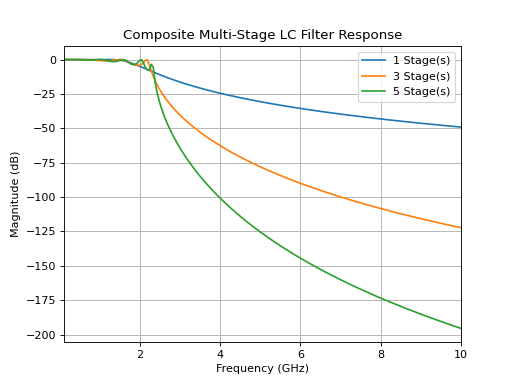
It is clear that the filter successfully starts to cut off at 2.4 GHz, and that the amount of roll-off increases as more stages are added.