Custom Parametric Models
Sometimes, it is more convenient or elegant to define a custom model that is not available in ParamRF. For example, you may want to:
Define a model using a custom S-parameter equation
Define a reusable component built from sub-models
Expose another model’s parameters under different names/paths
Implement a specialized version of an existing model
Add methods on top of your model e.g. for conversions/analysis
In ParamRF, this is done by inheriting directly from Model and overriding at least one of its core methods, namely s(), a(), y(), z(), build(), or primary_matrix().
Defining a Capacitor
Let’s define a capacitor from first principles using its ABCD parameters:
import pmrf as prf
import jax.numpy as jnp

class Capacitor(prf.Model):
    C: prf.Param

    def a(self, freq: prf.Frequency) -> jnp.ndarray:
        w, C = freq.w, self.C
        ones, zeros = jnp.ones_like(w), jnp.zeros_like(w)

        return jnp.array([
            [ones,  1.0 / (1j * w * C)],
            [zeros, ones]
        ]).transpose(2, 0, 1)
By inheriting from Model, Capacitor becomes both a Python dataclass and a JAX PyTree! For those familiar with dataclasses, this means that any standard dataclass syntax applies.
Note that Param is a merely a field type-hint, and does not enforce that the resulting field is actually a parameter and is registered as such. To ensure that the caller’s value is register as either a fixed or variable parameter so that it is returned by pmrf.Model.named_params(), and to also specify parameter constraints and additional features, we can use a field specifier.
Adding a Field Specifier
ParamRF provides two field specifiers: field and param. For parameters, param allows the following:
Setting a default value
Specifying parameter constraints that are inherent to the model
Attaching additional metadata and scaling at the model level
Auto-converting floats and other array-like values into variable/fixed parameters
The code below demonstrates this by extending the previous class, while constraining C to be only positive and defining the capacitance in terms of picofarads (pF) instead of farads (F):
# <previous imports>
from pmrf.constraints import Positive

class Capacitor(Capacitor):
    C: prf.Param = prf.param(constraint=Positive(), as_free=True, scale=1e-12)

    # def a(self, freq: prf.Frequency) -> jnp.ndarray:
        # <same as before>
By passing as_free=True, ParamRF will enforce that the incoming value is a tunable parameter even if a float is passed. Similarly, as_fixed=True can be used to fix any incoming parameters. However, these converters are entirely optionaly, and by default the parameter’s “tunability” is left unchanged, which is the most common use-case (simply registering the value in the parameter hierarchy).
Note that constraints will also always be enforced (even for unconstrained optimizers!), and will also automatically be intersected with any new constraints provided by the caller.
Evaluating the S-parameters
We can now create a capacitor and plot its S-parameters:
cap = Capacitor(1.0)
cap.plot_s_db(prf.Frequency(10, 100, 101, 'MHz'), m=1, n=0)
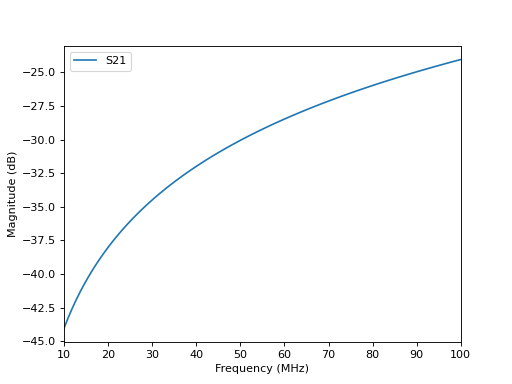
ParamRF will automatically perform the conversion between ABCD and S-parameters internally.